Baby Jack’s Fall Houndstooth Sweater – Free Crochet Pattern
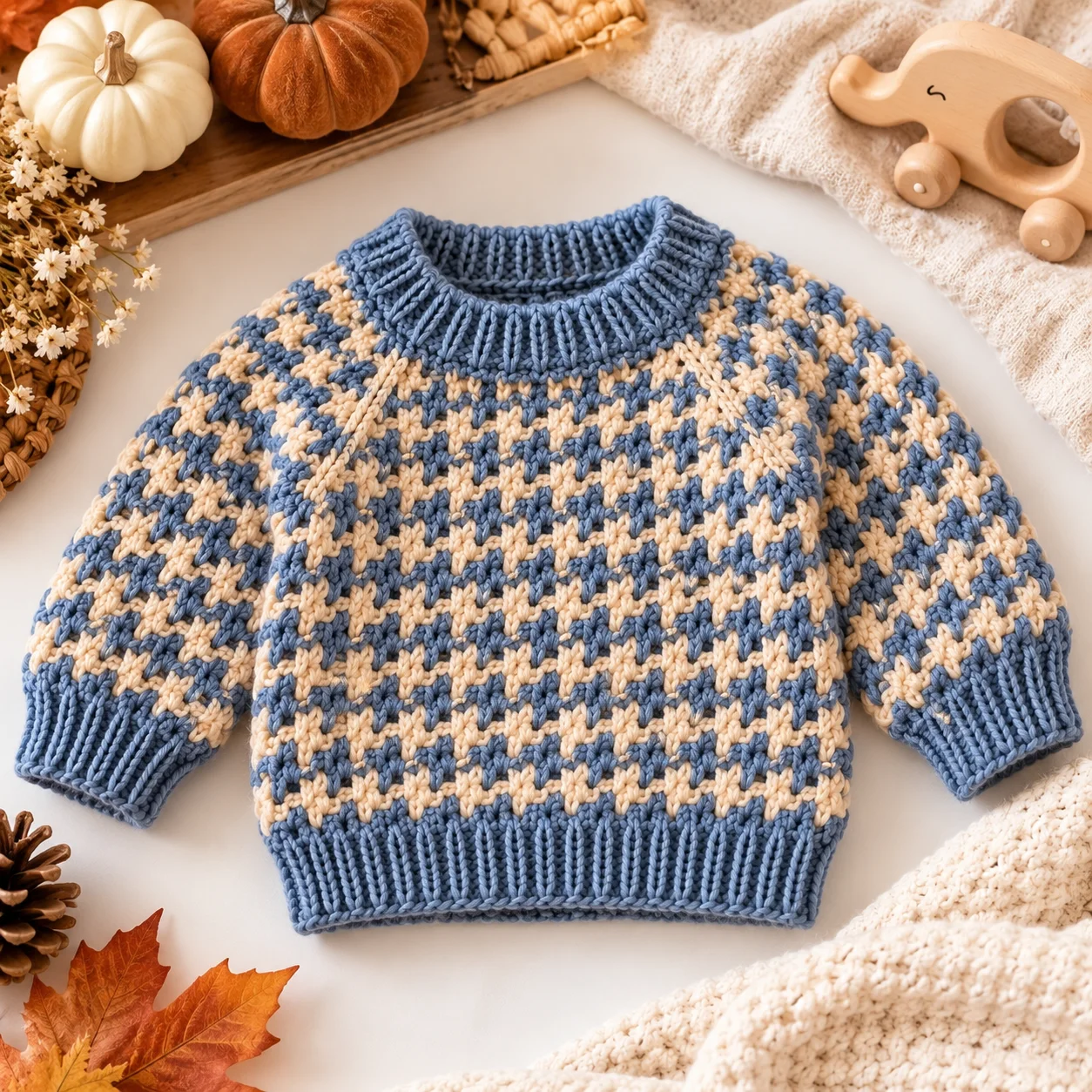
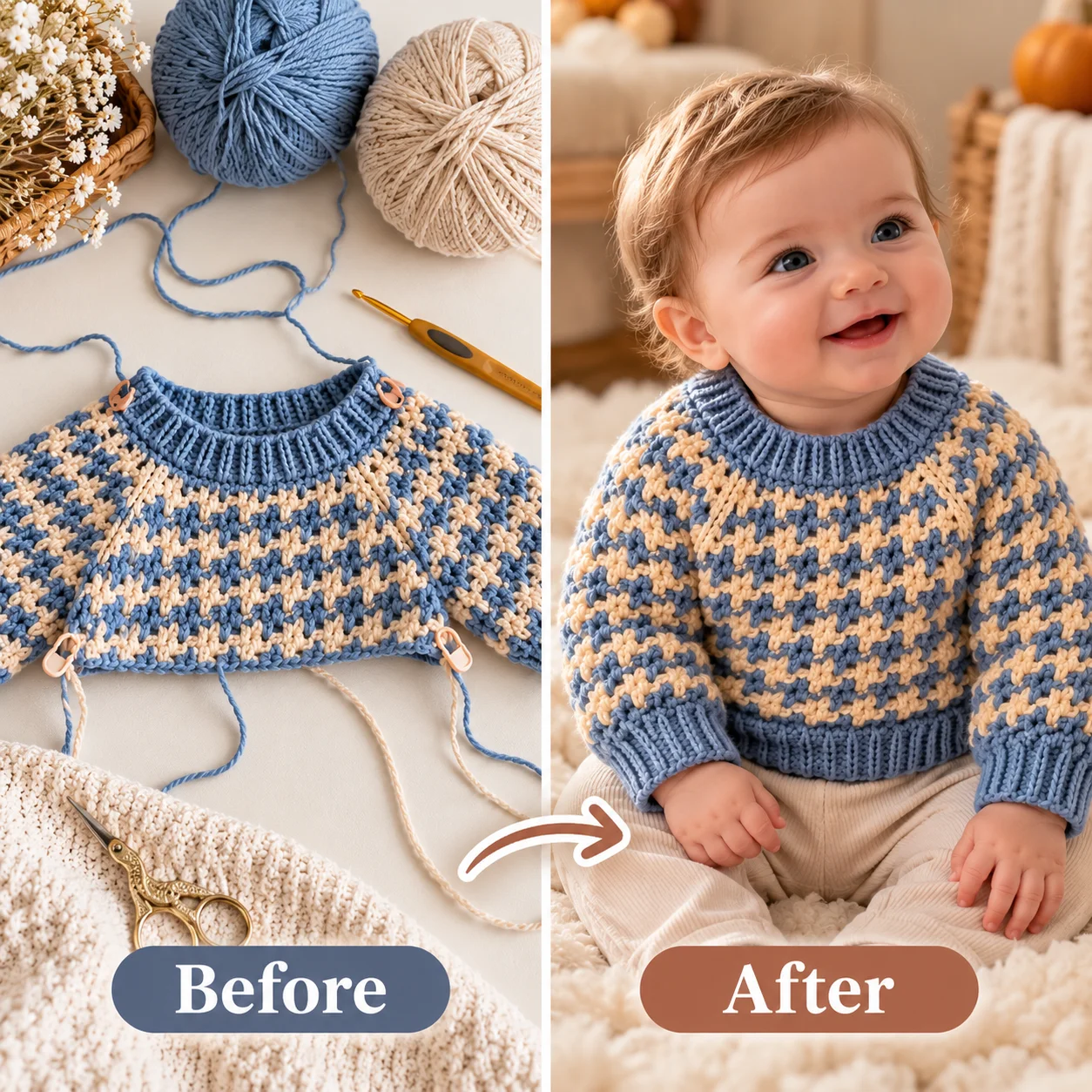
Baby Jack’s Fall Houndstooth Sweater is a cozy crochet pullover featuring a classic two-color houndstooth effect. The textured fabric is created with the griddle stitch, which alternates single crochet and double crochet stitches. Changing colors between rounds gives the sweater its distinctive houndstooth-inspired look.
This adorable baby sweater is worked from the neckline down, making it easy to adjust the length as you crochet. The sleeves are worked directly from the armholes, so there is very little sewing or assembly required.
Project Overview
- Project Type: Baby sweater
- Size: 12 months
- Construction: Top-down pullover
- Main Stitch: Griddle stitch
- Colors: 2
- Yarn: Bernat Softee Cotton
- Hook: US G/4.00 mm crochet hook
- Skill Level: Intermediate
Materials
For this crochet baby sweater, you will need:
- Bernat Softee Cotton, 60% cotton/40% acrylic
- 1 skein Seaside Blue
- 1 skein Sandstone
- US G/4.00 mm crochet hook
- Stitch markers
- Tapestry needle
- Scissors
It is a good idea to have extra yarn available if you plan to make adjustments to the length or size.
Crochet Abbreviations
This pattern uses standard US crochet terminology.
- ch – chain
- sc – single crochet
- dc – double crochet
- sl st – slip stitch
- sc2tog – single crochet two together
- FPDC – front post double crochet
- BPDC – back post double crochet
- st – stitch
- sts – stitches
Gauge
4 inches = 16 stitches and 15 rows of pattern
Always make a gauge swatch before beginning the sweater. Your gauge can affect both the finished measurements and the fit of the garment.
Finished Size
This pattern is written for approximately a 12-month size.
If you want to make the sweater larger or smaller, the yoke, body, sleeves, and length will need to be adjusted proportionally.
The Griddle Stitch
The griddle stitch is the main stitch used throughout the sweater.
The basic stitch sequence alternates:
sc, dc, sc, dc
On the following round, the stitches are worked into the opposite stitch type below so that the single crochets and double crochets alternate throughout the fabric.
The two-color round changes create the houndstooth effect.
How to Change Colors
Work the final stitch of a round until the last step of the stitch. Before completing that final yarn over and pull-through, introduce the new color.
Keep your yarn changes consistent throughout the sweater so the color pattern remains even.
Crochet Instructions
Neckband
Using the first color, chain the required number of stitches for the neckline.
Work several rows of single crochet ribbing.
Fold the ribbing so the short ends meet and join them to form the neckline.
Next, work single crochet stitches around the edge of the neckband to establish the first round of the sweater.
For the original 12-month construction, the neckline is worked around 56 stitches.
Place stitch markers to identify the four points where the yoke increases will be made.
Yoke
Begin working the griddle stitch around the neckline.
At each marked increase point, work 3 stitches into the designated stitch to create the raglan-style shaping.
The increase points gradually expand the sweater from the neckline toward the armholes.
Work the yoke in joined rounds, alternating the two colors from round to round.
Remember to keep your increase points marked throughout this section.
Continue until the yoke reaches the appropriate depth for separating the sleeves from the body.
Separating the Sleeves
Once the yoke is large enough, separate the sleeves from the body.
At each armhole, create the underarm opening with a chain-4 space.
Continue crocheting around the body, working the griddle stitch across the front and back sections and into the chain spaces at the underarms.
Join the round and change colors as established.
Body
Continue working the griddle stitch in joined rounds around the body.
Maintain the alternating color pattern throughout the sweater.
Work until the body reaches the desired length.
For the original design, the body transitions from the houndstooth section into ribbing at the bottom edge.
Bottom Ribbing
Begin the lower ribbing with a decrease round.
Work:
3 sc, sc2tog
Repeat this sequence around the sweater.
Continue with the ribbed stitch pattern using alternating front post and back post double crochet stitches.
The post stitches create a stretchy ribbed texture that gives the bottom of the sweater a finished appearance.
Work several rounds of ribbing and fasten off.
Sleeves
Return to one of the armholes.
Attach the yarn at the underarm area and work the griddle stitch around the opening.
Continue working in joined rounds.
Maintain the same two-color sequence used on the body.
Because the sleeves are worked directly from the armholes, there is no need to sew separate sleeves onto the sweater.
Continue until the sleeve reaches the desired length.
The sleeves can be made slightly longer if you want the cuffs to fold back.
Sleeve Cuffs
Work a decrease round near the wrist to gradually reduce the sleeve circumference.
Then begin the ribbing.
Use alternating:
FPDC, BPDC
to create the ribbed cuff.
Continue for several rounds, then fasten off.
Repeat the same process for the second sleeve.
Count the stitches and rounds on the first sleeve so the second sleeve matches.
Finishing
Once the sweater is complete:
- Fasten off all remaining yarn.
- Use a tapestry needle to weave in the ends securely.
- Check the underarm areas for loose stitches.
- Make sure both sleeves are the same length.
- Gently shape the sweater if necessary.
- Wash and dry according to the yarn manufacturer’s care instructions.
Tips for Crocheting the Sweater
Use stitch markers
The yoke relies on four increase points. Stitch markers make it much easier to identify these locations and prevent mistakes.
Keep the color changes consistent
The houndstooth effect depends on the two colors alternating predictably. Try to change colors at the same point at the end of every round.
Count your stitches
Garment patterns can become difficult to correct after several rounds. Counting periodically is much easier than trying to find a missing increase later.
Make both sleeves match
After completing the first sleeve, write down the number of rounds you worked. This makes it easier to reproduce the same length on the second sleeve.
Check your gauge
If your gauge is too loose, the sweater may turn out larger than expected. If your gauge is too tight, the finished sweater may be smaller.
Color Ideas
Although the original color combination has a classic fall feel, this sweater would look beautiful in many color combinations.
Try:
- Rust and cream
- Olive green and beige
- Burgundy and ivory
- Navy and light gray
- Mustard and charcoal
- Forest green and cream
- Terracotta and oatmeal
For a softer baby look, pastel blue and cream or dusty rose and ivory would also work beautifully.
Common Mistakes to Avoid
Losing an increase point
If you accidentally stop increasing at one of the four yoke points, the sweater may become uneven. Keep all four markers in place until the yoke is complete.
Changing colors inconsistently
Changing colors in different places from round to round can interrupt the houndstooth effect.
Skipping the gauge swatch
Even a small difference in gauge can make a noticeable difference in a baby garment.
Making the sleeves different lengths
Count your rounds on the first sleeve and use that number as a reference when making the second sleeve.
FAQ
What stitch is used for the houndstooth effect?
The sweater uses the griddle stitch, which combines alternating single crochet and double crochet stitches. The two-color pattern creates the houndstooth appearance.
What size is this baby sweater?
The pattern is written for approximately a 12-month size.
What yarn is used?
The original design uses Bernat Softee Cotton, a cotton/acrylic blend.
What crochet hook size do I need?
A US G/4.00 mm crochet hook is used for the original design.
Is this sweater suitable for beginners?
The basic stitches are beginner-friendly, but the complete sweater is better suited to an intermediate crocheter because it involves shaping, joined rounds, color changes, and post-stitch ribbing.
Can I make the sweater in another size?
Yes, the construction can be adapted, but changing sizes requires recalculating the yoke, armholes, body, sleeves, and finished length. Do not simply add random rounds or stitches without checking the proportions.
Can I use a different yarn?
You can substitute yarn, but choose a yarn with a similar weight and make a gauge swatch first. Changing yarn weight or hook size can significantly alter the finished measurements.
Final Thoughts
Baby Jack’s Fall Houndstooth Sweater is a charming crochet project for cooler weather. The combination of textured griddle stitch, contrasting colors, and ribbed cuffs gives this little pullover a classic handmade look.
The top-down construction also makes the sweater especially convenient to crochet because the body and sleeves can be worked directly from the yoke. Once you understand the color changes and increase points, the repeating stitch pattern becomes easy to follow.
Choose your favorite fall-inspired color combination, check your gauge, and enjoy creating a cozy handmade sweater for a little one.